Free · no sign-up · prints on letter or A4
Math Problems for 5th Graders
Make math problems for 5th graders: 4-digit addition and subtraction, 2-digit by 2-digit multiplication and division with remainders. Printable, with key.
Grades 4–5Multi-digit arithmeticCCSS 4.NBT.B.4, 4.NBT.B.5, 4.NBT.B.6, 5.NBT.B.5
Name: ____________________ Date: ______________
Grades 4–5 · Multi-digit arithmetic · CCSS 4.NBT.B.4, 4.NBT.B.5, 4.NBT.B.6, 5.NBT.B.5
Answer key
k5print.com
Need 20 different versions at once, your own logo, no ads? Teacher Plan is coming — join the waitlist →
Grade levels and Common Core standards for this tool
The grade and standard on each sheet follow your settings. Here is every combination this tool can make:
| Grade | Skill | Common Core |
|---|---|---|
| Grades K–1 | Mixed operations (in a mixed sheet) | K.OA.A.2, 1.OA.C.6 |
| Grades 1–2 | Mixed operations (in a mixed sheet) | 1.OA.C.6, 2.OA.B.2 |
| Grade 2 | Mixed operations (in a mixed sheet) | 2.NBT.B.5, 2.NBT.B.7 |
| Grades 3–4 | Mixed operations (in a mixed sheet) | 3.NBT.A.2, 4.NBT.B.4 |
| Grade 4 | Mixed operations (in a mixed sheet) | 4.NBT.B.4 |
| Grade 2 | Mixed operations (in a mixed sheet) | 2.NBT.B.5 |
| Grades 2–3 | Mixed operations (in a mixed sheet) | 2.NBT.B.7, 3.NBT.A.2 |
| Grade 3 | Mixed operations (in a mixed sheet) | 3.OA.C.7 |
| Grades 3–4 | Mixed operations (in a mixed sheet) | 3.OA.C.7, 4.NBT.B.5 |
| Grade 4 | Mixed operations (in a mixed sheet) | 4.NBT.B.5 |
| Grades 3–4 | Mixed operations (in a mixed sheet) | 3.OA.C.7, 4.NBT.B.6 |
| Grade 4 | Mixed operations (in a mixed sheet) | 4.NBT.B.6 |
| Grades 4–5 | Mixed operations (in a mixed sheet) | 4.NBT.B.5, 5.NBT.B.5 |
- CCSS K.OA.A.2
- Solve addition and subtraction word problems, and add and subtract within 10, e.g., by using objects or drawings to represent the problem.
- CCSS 1.OA.C.6
- Add and subtract within 20, demonstrating fluency for addition and subtraction within 10. Use strategies such as counting on; making ten (e.g., 8 + 6 = 8 + 2 + 4 = 10 + 4 = 14); decomposing a number leading to a ten (e.g., 13 - 4 = 13 - 3 - 1 = 10 - 1 = 9); using the relationship between addition and subtraction (e.g., knowing that 8 + 4 = 12, one knows 12 - 8 = 4); and creating equivalent but easier or known sums (e.g., adding 6 + 7 by creating the known equivalent 6 + 6 + 1 = 12 + 1 = 13).
- CCSS 2.OA.B.2
- Fluently add and subtract within 20 using mental strategies. By end of Grade 2, know from memory all sums of two one-digit numbers.
- CCSS 2.NBT.B.5
- Fluently add and subtract within 100 using strategies based on place value, properties of operations, and/or the relationship between addition and subtraction.
- CCSS 2.NBT.B.7
- Add and subtract within 1000, using concrete models or drawings and strategies based on place value, properties of operations, and/or the relationship between addition and subtraction; relate the strategy to a written method. Understand that in adding or subtracting three-digit numbers, one adds or subtracts hundreds and hundreds, tens and tens, ones and ones; and sometimes it is necessary to compose or decompose tens or hundreds.
- CCSS 3.NBT.A.2
- Fluently add and subtract within 1000 using strategies and algorithms based on place value, properties of operations, and/or the relationship between addition and subtraction.
- CCSS 4.NBT.B.4
- Fluently add and subtract multi-digit whole numbers using the standard algorithm.
- CCSS 3.OA.C.7
- Fluently multiply and divide within 100, using strategies such as the relationship between multiplication and division (e.g., knowing that 8 × 5 = 40, one knows 40 ÷ 5 = 8) or properties of operations. By the end of Grade 3, know from memory all products of two one-digit numbers.
- CCSS 4.NBT.B.5
- Multiply a whole number of up to four digits by a one-digit whole number, and multiply two two-digit numbers, using strategies based on place value and the properties of operations. Illustrate and explain the calculation by using equations, rectangular arrays, and/or area models.
- CCSS 4.NBT.B.6
- Find whole-number quotients and remainders with up to four-digit dividends and one-digit divisors, using strategies based on place value, the properties of operations, and/or the relationship between multiplication and division. Illustrate and explain the calculation by using equations, rectangular arrays, and/or area models.
- CCSS 5.NBT.B.5
- Fluently multiply multi-digit whole numbers using the standard algorithm.
Standards text quoted from corestandards.org. K5Print is not affiliated with or endorsed by the Common Core State Standards Initiative.
© Copyright 2010. National Governors Association Center for Best Practices and Council of Chief State School Officers. All rights reserved.
This page makes math problems for 5th graders: 4-digit addition and subtraction, 2-digit by 2-digit multiplication and division with remainders, mixed on one printable sheet with an answer key. It starts with 20 problems that fit on one page, and the numbers change every time you make a new sheet. It runs in your web browser, it is free, and nothing is uploaded.
Fifth grade math also includes fractions, decimals, volume and the coordinate plane, which this page does not make. It is for whole-number arithmetic. The related tools cover fractions, decimals, long division with two-digit divisors and area.
You can use what you make here in class or in things you sell, such as Etsy printables and Teachers Pay Teachers, with no credit needed.
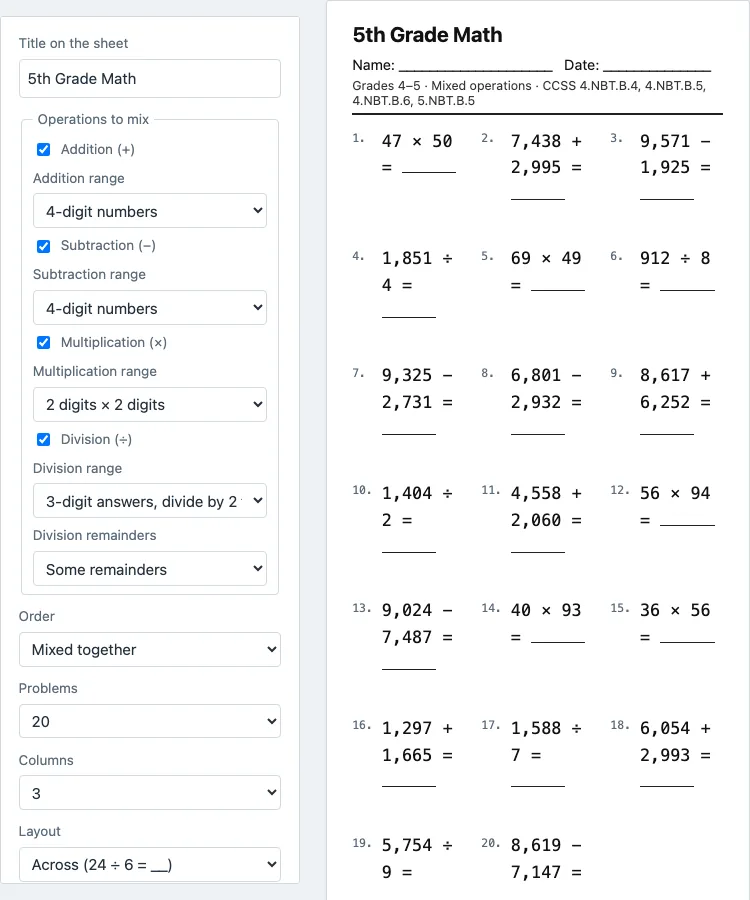
How to make math problems for 5th graders
- Type a heading in Title on the sheet, or keep the one provided.
- Tick the operations you want: Addition (+), Subtraction (−), Multiplication (×) and Division (÷).
- Open each range menu. This page starts with Addition and Subtraction at 4-digit numbers, Multiplication at 2 digits × 2 digits and Division at 3-digit answers with divisors from 2 to 9. Division remainders is set to Some remainders, so some answers have a remainder.
- Set Order to Mixed together or Grouped by operation. Grouped is easier to mark; mixed checks that the child picks the right operation.
- Set Problems (8 to 40) and Columns (2 to 6), and choose Layout: Across (24 ÷ 6 = __) or Stacked.
- Keep Include answer key ticked to print the key on its own page.
- Select Print or save as PDF. Use New worksheet for new numbers with the same settings, and Reset settings to go back to this page’s starting settings. Check the preview before you print. The key lists each answer, and for division it shows the remainder after the letter R.
Choose US Letter or A4 in the print dialog. The page address stores your settings, so a bookmarked or shared link opens the same sheet again. Every answer is checked a second way before it is used, and the key matches the sheet.
What math do 5th graders learn?
Fifth graders multiply multi-digit whole numbers (5.NBT.B.5), divide up to four-digit numbers by two-digit numbers (5.NBT.B.6), work with decimals to the thousandths and add, subtract and multiply fractions. They also study volume, the coordinate plane and expressions. This page makes the whole-number arithmetic. Addition, subtraction and division with these number sizes build on 4th grade skills (4.NBT.B.4, 4.NBT.B.6).
Does the division go up to two-digit divisors?
No. Division on this page uses divisors from 2 to 9, with answers that have up to 3 digits. The 5th grade standard goes further, to two-digit divisors. For that, use the long division worksheets, which can make a divisor of two or three digits and show a bracket with working space.
Are these word problems?
No. They are number problems such as 482 × 36 = __, with an answer key. The page makes equations, not stories. Use them to build fluency with the steps, then ask your child to make up a story that matches one of the problems.
How can I use the sheets?
Use Grouped by operation to practice one skill at a time. Start with 10 problems of 2-digit multiplication, because each one has several steps. If errors pile up, make the numbers smaller: 2 digits × 1 digit for multiplication, 2-digit numbers for addition and subtraction.
What should a 5th grader do when a problem is wrong?
Find where it went wrong before redoing it. For multiplication, check each partial product and the place where the tens row begins. For division with a remainder, check that the remainder is smaller than the divisor, and that quotient × divisor + remainder gives back the number you started with. These checks work with any problem on the sheet, and they are quicker than redoing the whole problem.
How do I use the sheets for review before a test?
Two weeks before a unit test, print a mixed sheet every other day and a grouped sheet on the skill the child finds hardest. Keep the old sheets and keys. After each sheet, ask the child to explain one problem aloud. A child who can explain the steps knows the method; one who can only repeat them may still make mistakes under test pressure.
Questions teachers and parents ask
Are these math problems free?
Yes. The sheets are made in your web browser, nothing is uploaded, and no account or sign-up is needed.
Do these include fractions and decimals?
No. This page has addition, subtraction, multiplication and division of whole numbers. Fractions and decimals have their own tools, listed under More tools.
How are remainders shown?
In the answer key, a division with a remainder is written with R, for example 173 R4.
Can I make the problems easier?
Yes. Open each range menu and choose a smaller size, such as 2-digit numbers for addition or 2 digits × 1 digit for multiplication.
Are the answers checked?
Yes. Each problem is checked a second way before it is used, and the key prints the same answers as the sheet.
Can the sheet be a weekly test?
Yes. Make one sheet, print the key separately for marking, and use Reset settings and New worksheet next week for a different set at the same level. The worksheet code under the buttons lets you make the same sheet again.
How many problems should a 5th grader do at once?
Ten to twenty is usual. Multi-digit problems have several steps, so a short sheet done carefully is better than a long one done fast. The default is 20 mixed problems; choose 10 for a quicker check or when you pick the harder ranges.
Can I sell the worksheets I make here?
Yes. The sheets you make here are royalty-free for personal, classroom and commercial use, including Etsy printables, Teachers Pay Teachers and Amazon KDP workbooks. You do not need to give credit. The only limit is that you may not copy the generator itself to run a competing service; see the [terms](/terms/).
Updated